OVERVIEW
Nature’s Regenerative Oil for Radiant, Youthful-Looking Skin
Overview
Rosehip Oil is a lightweight botanical oil obtained primarily from the seeds of rosehip fruits from Rosa species, especially Rosa canina. Naturally rich in essential fatty acids, tocopherols, carotenoids, phytosterols and other antioxidant compounds, it is especially valued in skincare for supporting the skin barrier, softness, elasticity and a healthy-looking complexion.
Unlike rose essential oil, Rosehip Oil is a carrier/fixed oil, not a concentrated aromatic essential oil. Its naturally occurring linoleic, alpha-linolenic and oleic fatty acids make it particularly useful for facial and body care.
Regular topical use can help nourish dry or environmentally stressed skin and improve the appearance of uneven texture, fine lines, pigmentation and scars. Research on rosehip preparations is promising, although evidence for treating specific medical skin conditions remains limited.
Benefits
1. ✨ Supports Youthful-Looking Skin
Rosehip Oil provides essential fatty acids and antioxidant compounds that help maintain the skin’s natural barrier and protect against oxidative stress. With regular use, skin may appear smoother, softer and more supple.
Ideal for: Mature, dry, dull and environmentally stressed skin.
2. 💧 Deeply Nourishes & Softens
Its linoleic, alpha-linolenic and oleic fatty acids replenish lipids on the skin surface and help reduce moisture loss.
This makes Rosehip Oil particularly useful for:
- Dry facial skin
- Rough elbows and knees
- Dry hands
- Heels and feet
- Dry areas of the body
Skin feels softer and better conditioned without requiring a heavy cream.
3. 🌿 Supports the Skin Barrier
Linoleic acid is an important fatty acid associated with normal epidermal barrier function.
Rosehip Oil can therefore be incorporated into routines designed to support skin that feels dry, tight or compromised by environmental exposure.
4. 🌟 Helps Improve the Appearance of Uneven Skin Tone
Rosehip contains carotenoids and other antioxidant compounds. Consistent skincare use may help create a brighter, more even-looking complexion and reduce the visible appearance of some forms of discoloration.
It is a useful addition to routines targeting:
dullness • uneven tone • sun-stressed appearance • post-blemish marks
Rosehip Oil does not replace sunscreen.
5. 🩹 Helps Improve the Appearance of Scars
Rosehip Oil is widely used cosmetically for scar care.
Some human research suggests rosehip-containing topical preparations may improve aspects of postsurgical scar appearance, including redness, but the clinical evidence remains limited.
For scars, use it only after the wound has completely closed, unless a healthcare professional advises otherwise.
6. 🌸 Helps Calm Dry, Stressed-Looking Skin
The combination of polyunsaturated fatty acids and antioxidants gives Rosehip Oil potentially useful anti-inflammatory and skin-conditioning properties.
It may help make mildly dry or irritated-looking skin feel more comfortable.
It should not, however, be promoted as a treatment for eczema, dermatitis, psoriasis or other medical skin diseases.
7. 💆 Supports Healthy-Looking Hair & Scalp
Although Rosehip Oil is best known for skincare, its emollient properties also make it useful for dry hair ends, beard care and dry scalp massage.
A small amount can:
- Smooth dry-looking hair
- Condition hair ends
- Add natural-looking shine
- Soften beard hair
- Condition dry scalp
Ingredients
NATURAL COMPOSITION / INGREDIENTS
For a 100% pure Rosehip Seed Oil, the product ingredient declaration can simply be:
Ingredient: 100% Rosa Canina Seed Oil
Rosehip seed oil naturally contains a mixture of beneficial lipid-soluble compounds.
Key Natural Components
Linoleic Acid — Omega-6
Usually one of the predominant fatty acids. Supports skin conditioning and barrier function.
Alpha-Linolenic Acid — Omega-3
A polyunsaturated fatty acid contributing to the oil’s nourishing and skin-conditioning properties.
Oleic Acid — Omega-9
Helps soften and condition skin.
Tocopherols — Vitamin E compounds
Natural lipid-soluble antioxidants that help protect the oil and contribute antioxidant activity.
Carotenoids
Rosehip-derived materials may contain compounds such as beta-carotene, lycopene, lutein and zeaxanthin.
Phytosterols
Including compounds such as beta-sitosterol and campesterol.
Phenolic compounds
Additional naturally occurring plant antioxidants.
Important: Rosehip fruit is famous for its high vitamin C content, but this should not be interpreted to mean that every bottle of cold-pressed Rosehip Seed Oil contains a clinically meaningful amount of vitamin C. The composition varies considerably with species, processing and extraction method.
Guide
HOW TO USE ROSEHIP OIL
🌙 1. Face — Daily Anti-Aging Routine
Night: Cleanse the face and leave the skin slightly damp. Place 2–3 drops of Rosehip Oil on your fingertips and gently massage over the face and neck.
It can be used alone or after a water-based serum/moisturizer.
For dry or mature skin, start once nightly.
✨ 2. Fine Lines & Dry Areas
Apply 1 drop between the fingertips and gently press onto areas that tend to become dry or show fine lines, such as the forehead, cheek area and around the mouth.
Avoid getting oil directly into the eyes.
🌟 3. Uneven Tone & Post-Blemish Marks
Apply 1–2 drops to the affected cosmetic area once daily, preferably in the evening.
For daytime pigmentation care, sunscreen remains essential because Rosehip Oil is not a sunscreen.
🩹 4. Scar Care
Once the skin is fully closed and healed, massage a small amount gently over the scar for approximately 1–2 minutes.
Use once or twice daily if well tolerated.
Do not apply to fresh surgical incisions, infected wounds, bleeding skin or open wounds without professional medical advice.
🤰 5. Stretch-Mark & Body Massage
Mix approximately:
5–10 drops Rosehip Oil + 1 teaspoon of a suitable carrier oil
Massage gently onto areas such as the abdomen, thighs, hips or upper arms.
Rosehip Oil can moisturize and condition stretched skin, but customers should not be promised that it will prevent or completely remove stretch marks.
💧 6. Dry Hands, Elbows, Knees & Heels
Add 2–4 drops to your regular body lotion or apply a thin layer directly to slightly damp skin.
For very dry heels, apply at night and follow with a richer moisturizer if necessary.
💆♀️ 7. Hair Ends
Rub 1–3 drops between the palms and lightly smooth over dry hair ends.
Start with a very small quantity to avoid making the hair greasy.
🌿 8. Dry Scalp Massage
Mix:
5 drops Rosehip Oil + 1 tablespoon Coconut/Jojoba Oil
Massage lightly into a dry scalp and leave for approximately 20–30 minutes, then shampoo normally.
Discontinue if scalp irritation occurs.
🧔 9. Beard Conditioning
Place 2–3 drops in the palms, rub together and massage through the beard and the skin underneath.
It can help soften beard hair and reduce a dry, rough feeling.
💅 10. Nail & Cuticle Care
Massage 1 drop across several nails and cuticles before bedtime.
This works primarily as a conditioning treatment for dry cuticles and surrounding skin.
OTHER USES
Rosehip Oil can also be incorporated into:
Facial massage • body massage blends • facial oils • creams • lotions • serums • lip-care formulations • beard oils • hair oils • body oils • after-sun moisturizing products
When formulating commercial products, percentages, stability, oxidation, preservation and compatibility should be assessed professionally.


 LEMONGRASS OIL - 10 ML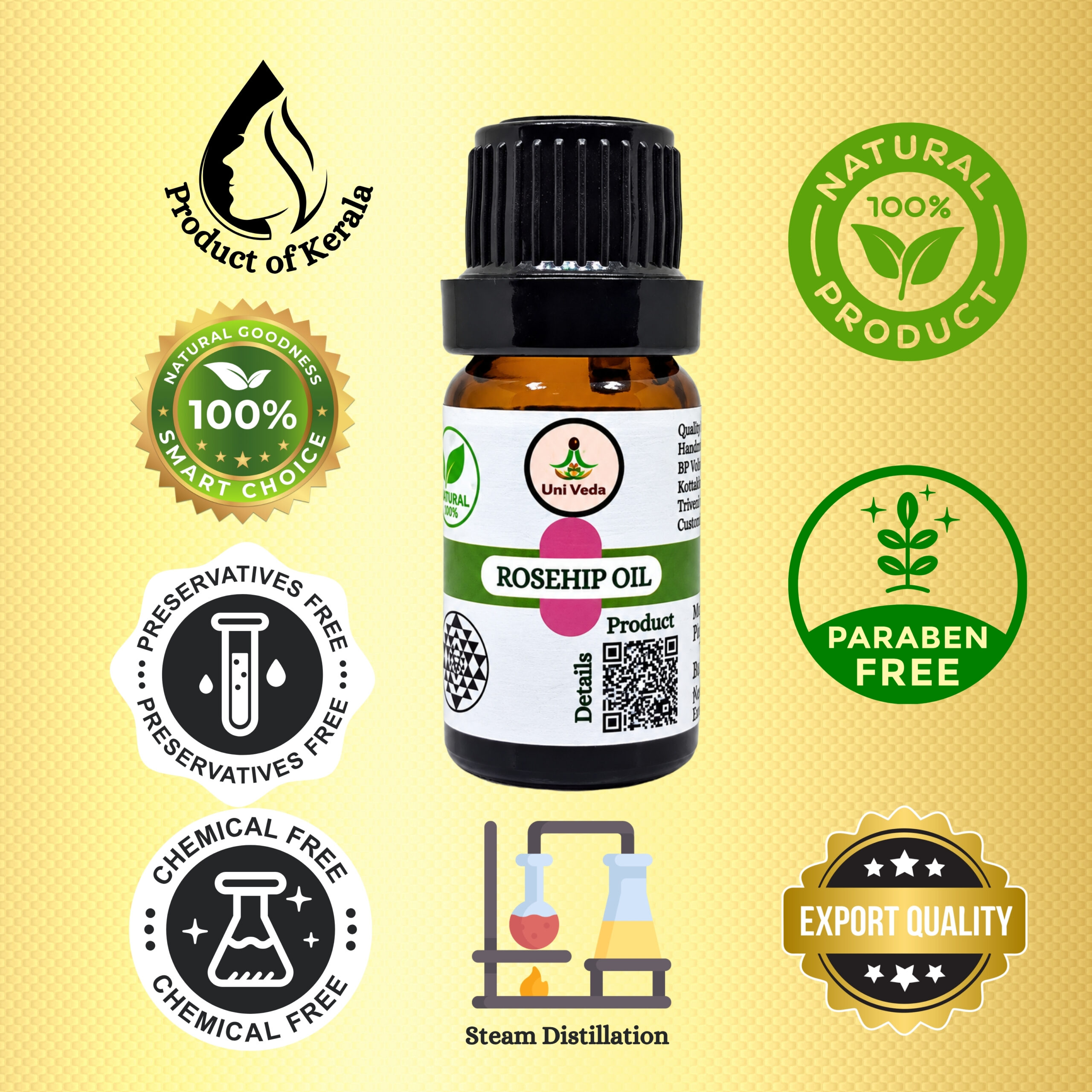
Reviews
There are no reviews yet.